FEEDING THERAPY
Happier Mealtimes Start Here
When your child eats only a handful of foods, avoids certain textures, struggles with chewing or swallowing, or becomes overwhelmed at mealtimes, eating can become stressful for the entire family.
At MeBe, feeding therapy starts with understanding why eating is difficult for your child. Our team looks beyond what’s happening at the table to understand the sensory, oral-motor, medical, behavioral, and developmental factors that may be contributing to feeding challenges.
Together, we’ll help your child build the skills and confidence they need to make meaningful progress — while helping your family feel more comfortable around the table.
Is Feeding Therapy Right for My Child?
Every child’s relationship with food is different. Feeding therapy may help if your child:
What looks like “picky eating” may actually be your child’s way of communicating that something about eating is difficult. Understanding what’s behind the challenge helps us determine how best to support them.
Understanding What’s Making Eating Difficult
Feeding is surprisingly complex. Eating involves sensory processing, motor coordination, oral-motor skills, learning, communication, behavior, and physical comfort — all working together.
That’s why MeBe takes a multidisciplinary approach to feeding therapy.
Depending on your child’s needs, Occupational Therapists, Speech-Language Pathologists, and Board Certified Behavior Analysts may work together to understand the factors contributing to your child’s feeding challenges and create an individualized plan.
Rather than focusing only on getting your child to eat more foods, we work to understand the underlying skills and experiences that may be making eating difficult.
Feeding Therapy, Tailored to Your Child
There’s no one-size-fits-all approach to feeding therapy.
We begin by getting to know your child — what they currently eat, how they respond to different foods, what mealtimes look like at home, and what’s most important to your family.
From there, we create goals around your child’s individual needs. Feeding therapy may include:
Progress doesn’t always begin with taking a bite. For some children, an important first step might be comfortably sitting near a new food, allowing it on their plate, touching it, or bringing it near their mouth.
Those small steps can build toward meaningful, lasting progress.
Research-Informed. Play-Based. Child-Focused.
Experts estimate that feeding disorders affect up to 80% of children with developmental disabilities, which can lead to medical, social, cognitive, and behavioral concerns.
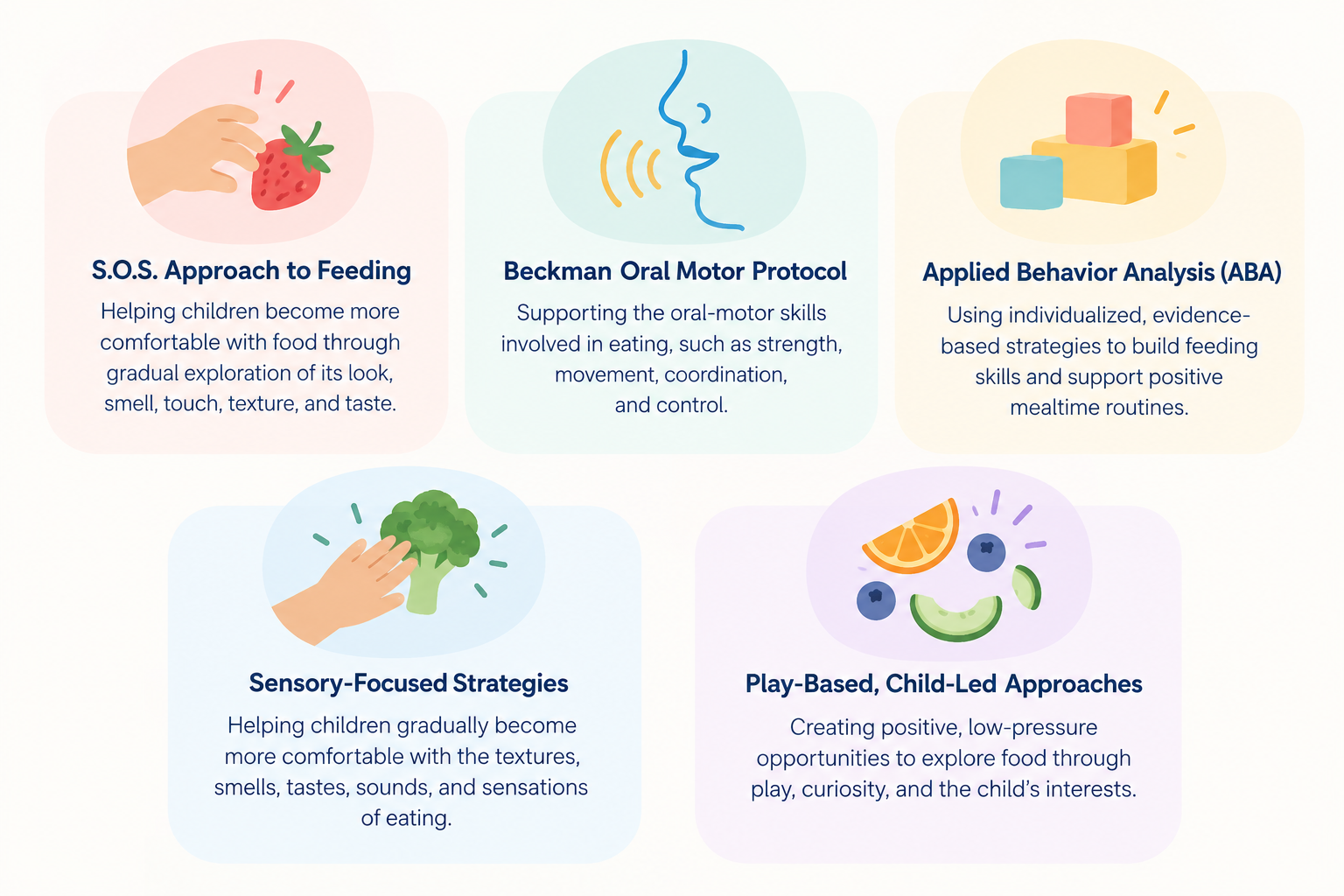
MeBe’s feeding professionals draw from established feeding approaches based on each child’s individual needs, including the S.O.S. Approach to Feeding, Beckman Oral Motor Protocol, Applied Behavior Analysis (ABA), sensory-focused strategies, and play-based, child-led approaches.
The goal isn’t to pressure a child into eating. It’s to help them develop the comfort, skills, and confidence that make eating easier — and help families create mealtimes that feel more successful.

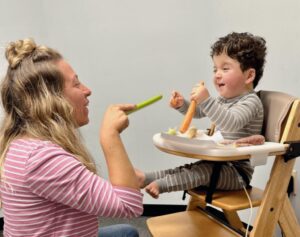
Building confidence through play and exploration
Parents Are Part of the Team
Feeding therapy doesn’t stop when a session ends.
Parents and caregivers are an important part of the process. We’ll help you understand what’s contributing to your child’s feeding challenges and give you practical strategies you can use during everyday meals and snacks.
For some families, telehealth feeding therapy may allow our team to work with you right where meals actually happen — at your own table — with an emphasis on parent education, coaching, and strategies that can carry across your child’s daily routines.
Progress Can Start Small — and Grow From There
Success in feeding therapy isn’t measured by whether your child suddenly eats everything on their plate.
It might mean trying a new texture. Sitting comfortably during a family meal. Adding another food to their diet. Learning to chew more effectively. Feeling less anxious when something unfamiliar appears on the table.
Over time, those steps can lead to greater independence, more variety, better mealtime experiences, and less stress for the whole family. Our collaborative teams tackle a wide range of feeding behaviors, including sensory processing issues, oral motor skills, and mealtime behaviors, such as:
- Food aversion
- Pocketing food in the mouth rather than chewing and swallowing
- Difficulty with the oral motor skills needed to eat correctly
- Stress or meltdowns around coming to the table




MeBe Feeding Therapy Resources
For more information on Feeding Disorders and Feeding Therapy, check out our feeding therapy videos on the MeBe YouTube Channel.